
SARIMAX python np.linalg.linalg.LinAlgError: LU decomposition error
See original GitHub issueHello, I have a problem with time series analysis. I have a dataset with 5 features. Following is the subset of my input dataset:
date,price,year,day,totaltx 1/1/2016 0:00,434.46,2016,1,126762 1/2/2016 0:00,433.59,2016,2,147449 1/3/2016 0:00,430.36,2016,3,148661 1/4/2016 0:00,433.49,2016,4,185279 1/5/2016 0:00,432.25,2016,5,178723 1/6/2016 0:00,429.46,2016,6,184207
My endogenous data is price column and exogenous data is totaltx price. This is the code I am running and getting an error:
import statsmodels.api as sm
import pandas as pd
import numpy as np
from numpy.linalg import LinAlgError

def arima(filteredData, coinOutput, window, horizon, trainLength):
    start_index = 0
    end_index = 0
    inputNumber = filteredData.shape[0]
    predictions = np.array([], dtype=np.float32)
    prices = np.array([], dtype=np.float32)
    # sliding on time series data with 1 day step
    while ((end_index) < inputNumber - 1):
        end_index = start_index + trainLength
        trainFeatures = filteredData[start_index:end_index]["totaltx"]
        trainOutput = coinOutput[start_index:end_index]["price"]

        arima = sm.tsa.statespace.SARIMAX(endog=trainOutput.values, exog=trainFeatures.values, order=(window, 0, 0))
        arima_fit = arima.fit(disp=0)
        testdata=filteredData[end_index:end_index+1]["totaltx"]
        total_sample = end_index-start_index
        predicted = arima_fit.predict(start=total_sample, end=total_sample, exog=np.array(testdata.values).reshape(-1,1))
        price = coinOutput[end_index:end_index + 1]["price"].values

        predictions = np.append(predictions, predicted)
        prices = np.append(prices, price)

        start_index = start_index + 1
    return predictions, prices

def processCoins(bitcoinPrice, window, horizon):
    output = bitcoinPrice[horizon:][["date", "day", "year", "price"]]
    return output

trainLength=100;
for window in [3,5]:
    for horizon in [1,2,5,7,10]:
        bitcoinPrice = pd.read_csv("..\\prices.csv", sep=",")
        coinOutput = processCoins(bitcoinPrice, window, horizon)
        predictions, prices = arima(bitcoinPrice, coinOutput, window, horizon, trainLength)
In this code, I am using rolling window regression technique. I am training arima for start_index:end_index and predicting the test data with end_index:end_index+1
This the error that is thrown from my code:
Traceback (most recent call last):
  File "C:/PycharmProjects/coinLogPrediction/src/arima.py", line 115, in <module>
    predictions, prices = arima(filteredBitcoinPrice, coinOutput, window, horizon, trainLength, outputFile)
  File "C:/PycharmProjects/coinLogPrediction/src/arima.py", line 64, in arima
    arima_fit = arima.fit(disp=0)
  File "C:\AppData\Local\Continuum\Anaconda3\lib\site-packages\statsmodels\tsa\statespace\mlemodel.py", line 469, in fit
    skip_hessian=True, **kwargs)
  File "C:\AppData\Local\Continuum\Anaconda3\lib\site-packages\statsmodels\base\model.py", line 466, in fit
    full_output=full_output)
  File "C:\AppData\Local\Continuum\Anaconda3\lib\site-packages\statsmodels\base\optimizer.py", line 191, in _fit
    hess=hessian)
  File "C:\AppData\Local\Continuum\Anaconda3\lib\site-packages\statsmodels\base\optimizer.py", line 410, in _fit_lbfgs
    **extra_kwargs)
  File "C:\AppData\Local\Continuum\Anaconda3\lib\site-packages\scipy\optimize\lbfgsb.py", line 193, in fmin_l_bfgs_b
    **opts)
  File "C:\AppData\Local\Continuum\Anaconda3\lib\site-packages\scipy\optimize\lbfgsb.py", line 328, in _minimize_lbfgsb
    f, g = func_and_grad(x)
  File "C:\AppData\Local\Continuum\Anaconda3\lib\site-packages\scipy\optimize\lbfgsb.py", line 273, in func_and_grad
    f = fun(x, *args)
  File "C:\AppData\Local\Continuum\Anaconda3\lib\site-packages\scipy\optimize\optimize.py", line 292, in function_wrapper
    return function(*(wrapper_args + args))
  File "C:\AppData\Local\Continuum\Anaconda3\lib\site-packages\statsmodels\base\model.py", line 440, in f
    return -self.loglike(params, *args) / nobs
  File "C:\AppData\Local\Continuum\Anaconda3\lib\site-packages\statsmodels\tsa\statespace\mlemodel.py", line 646, in loglike
    loglike = self.ssm.loglike(complex_step=complex_step, **kwargs)
  File "C:\AppData\Local\Continuum\Anaconda3\lib\site-packages\statsmodels\tsa\statespace\kalman_filter.py", line 825, in loglike
    kfilter = self._filter(**kwargs)
  File "C:\AppData\Local\Continuum\Anaconda3\lib\site-packages\statsmodels\tsa\statespace\kalman_filter.py", line 747, in _filter
    self._initialize_state(prefix=prefix, complex_step=complex_step)
  File "C:\AppData\Local\Continuum\Anaconda3\lib\site-packages\statsmodels\tsa\statespace\representation.py", line 723, in _initialize_state
    self._statespaces[prefix].initialize_stationary(complex_step)
  File "_representation.pyx", line 1351, in statsmodels.tsa.statespace._representation.dStatespace.initialize_stationary
  File "_tools.pyx", line 1151, in statsmodels.tsa.statespace._tools._dsolve_discrete_lyapunov
numpy.linalg.linalg.LinAlgError: LU decomposition error.
I believe that there is a bug in statsmodels if I do not have any error. Can you please help me to solve it?
Issue Analytics
- State:

- Created 5 years ago
- Comments:22 (6 by maintainers)
 Top Results From Across the Web
 Top Related Medium Post
 Top Related StackOverflow Question
 Troubleshoot Live Code
 Top Related Reddit Thread
 Top Related Hackernoon Post
 Top Related Tweet
 Top Related Dev.to Post
 Top Related Hashnode Post
Hi folks, I was having the same error,
Erroneous code: mod = sm.tsa.SARIMAX(y, order=(0 1,0), seasonal_order=(1,0,0,12)) res = mod.fit()
This gave me error : LinAlgError: Schur decomposition solver error
I was able to solve this error after doing some modification in code: mod = sm.tsa.SARIMAX(y, order=(0 1,0), seasonal_order=(1,0,0,12),enforce_stationarity=False) res = mod.fit()
Hope this helps…🙂
My solution for this error, was to manually check if the last value is 0 or not. I noticed that if last value of time series was 0, it would give me LU decomposition error. Therefore, I changed the last value to the date when the value is not 0 and the error was gone.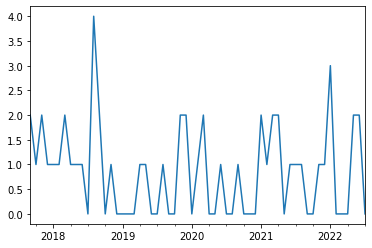 It gave me error for this, note the last value was 0.